
Securing the Autonomous Enterprise: Why Agentic AI Changes Everything for Cybersecurity
Presented by Bart Salaets, EMEA Field CTO & RVP Solution Architects at F5, at BE-CEC on November 25, 2026 in Faculty Club Leuven.
Artificial intelligence is moving rapidly from experimentation to enterprise-wide adoption. But while organisations are discovering the productivity benefits of AI, a new security challenge is emerging: what happens when AI stops simply answering questions and starts taking action?
That was the central question addressed by Bart Salaets, EMEA Field CTO & RVP Solution Architects at F5, during his presentation “Securing the Autonomous Enterprise: Navigating the Risks of Agentic AI” at the latest edition of Belgium's Cybersecurity Executives Conference (BE-CEC).
His message was clear: Organisations must rethink their approach to cybersecurity.
Traditional security controls were designed to protect users, devices, applications and APIs. Agentic AI introduces an entirely new category of actor: autonomous software that can understand intent, make decisions, interact with enterprise systems and execute actions on behalf of people.
The opportunities are considerable. So are the risks.
1. From generative AI to autonomous AI agents
The adoption of AI in organisations has evolved through several stages.
It started with employees using personal ChatGPT accounts, often without formal corporate approval. Organisations subsequently introduced enterprise-approved AI assistants such as Microsoft Copilot, followed by specialised AI applications, including internal chatbots, coding assistants and applications powered by Large Language Models (LLMs).
We are now entering the next phase: agentic AI.
Unlike traditional generative AI, which primarily responds to user prompts, AI agents can autonomously plan tasks, interact with tools, access information and execute actions.
With every step in this evolution, organisations have given AI systems more access and more autonomy. And with increasing access and autonomy comes increasing exposure to risk.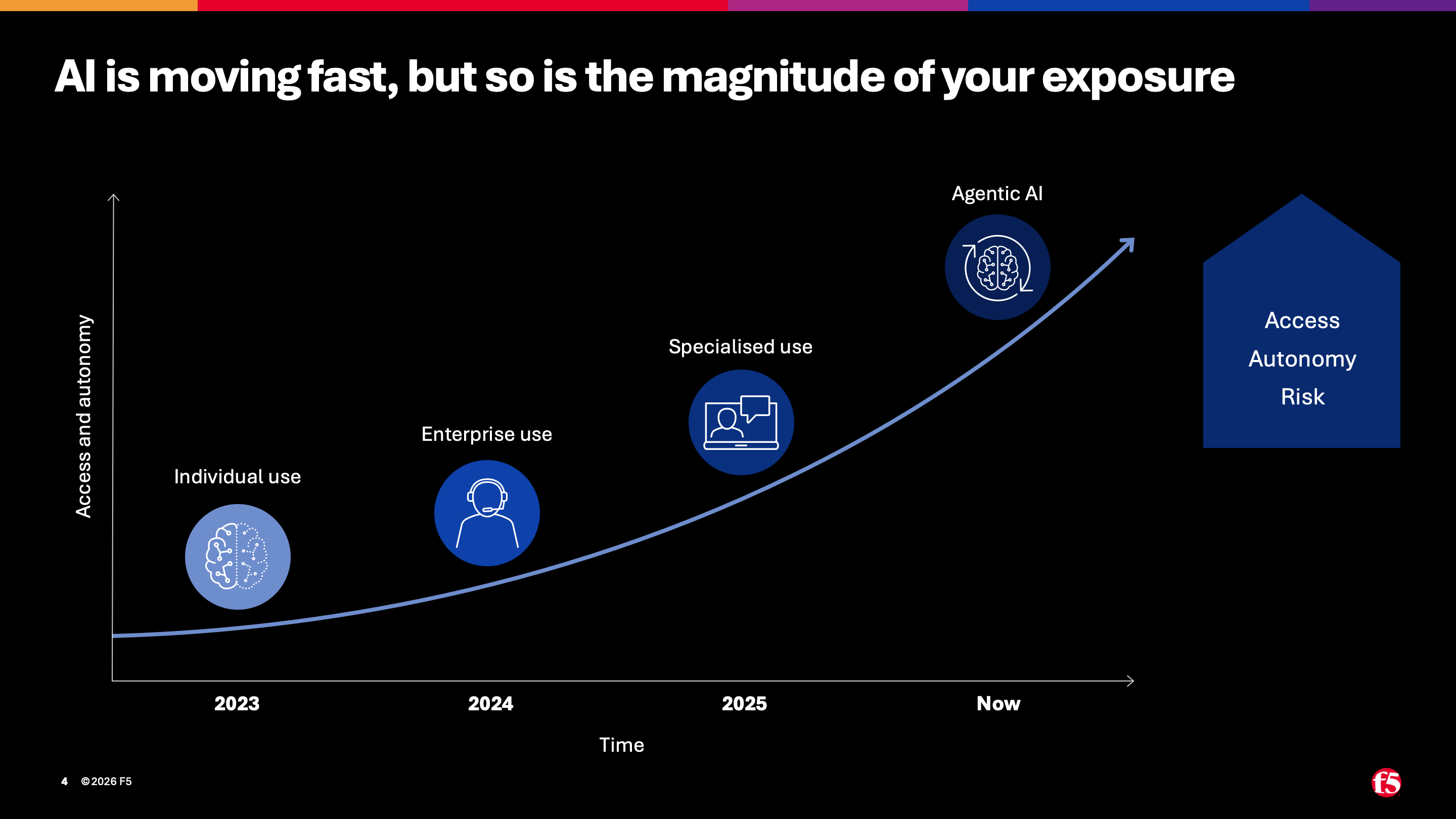
This slide illustrates how AI adoption has progressed from individual use to enterprise use, specialised applications and agentic AI. It also introduces the relationship between increasing access, autonomy and risk.
The challenge is that many organisations are adopting AI faster than they are developing the necessary security and governance frameworks.
Visibility, governance and security are increasingly becoming prerequisites for scaling AI safely.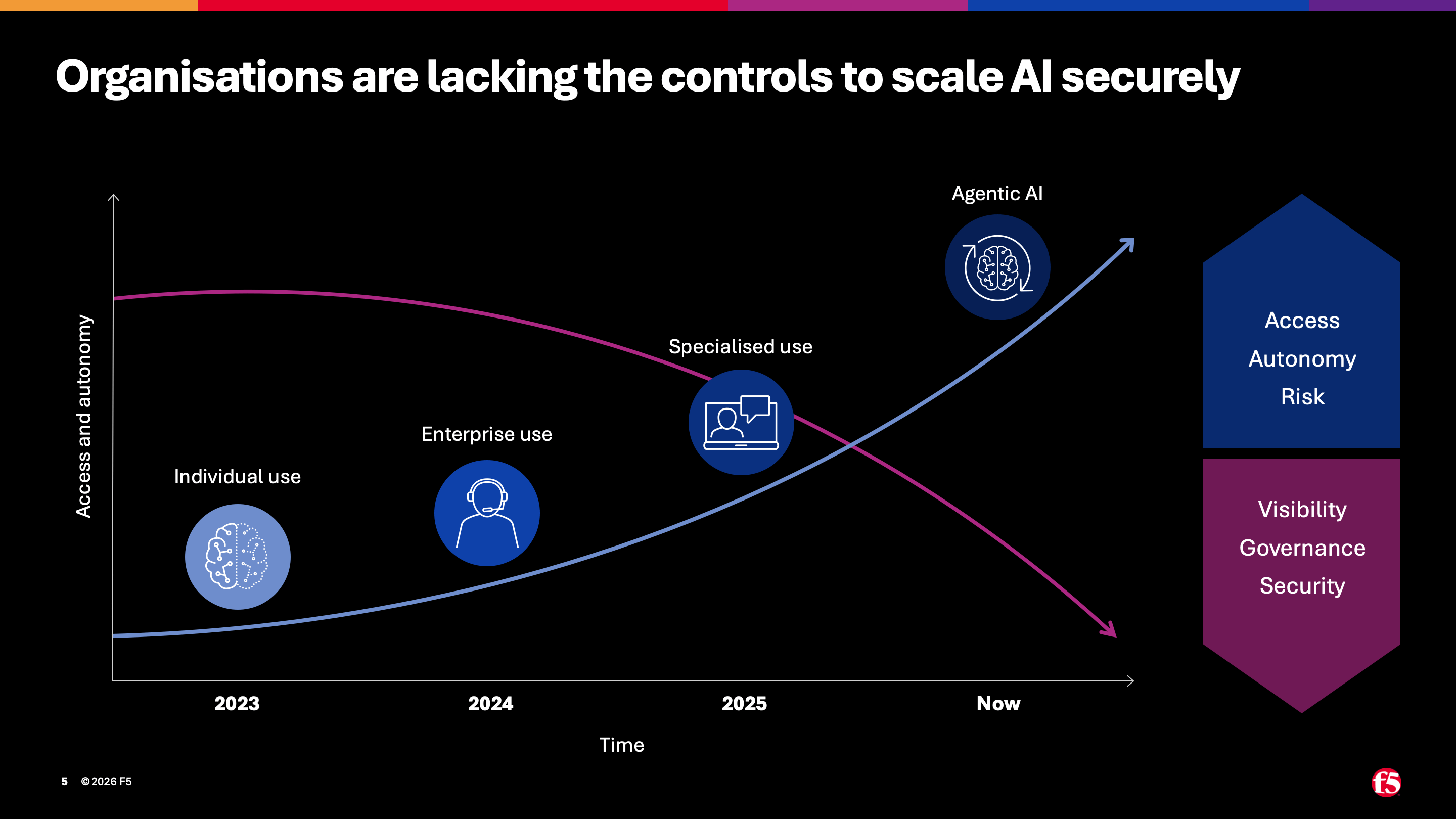
This slide highlights the growing gap between AI adoption and the ability of organisations to control it.
2. Why agentic AI fundamentally changes the security equation
One of Bart's most important observations was that agentic AI represents more than an incremental evolution of generative AI.
Traditional generative AI typically operates with a human in the loop. A user asks a question, the system generates an answer, and the user decides what to do next.
Agentic AI changes this model.
An agent can receive a goal, develop its own execution plan, retrieve information, interact with APIs, update enterprise systems and trigger subsequent actions. It can also maintain memory and coordinate with other agents.
The difference is significant:
Generative AI: User prompts drive individual answers.
Agentic AI: A goal triggers a dynamic sequence of decisions and actions.
Generative AI: Primarily generates and retrieves information.
Agentic AI: Can write, execute and modify things in enterprise environments.
Generative AI: Risks are often associated with information exposure.
Agentic AI: Risks increasingly involve execution, permissions and the speed at which actions take place.
This means that security teams are no longer dealing exclusively with information being accessed or generated. They must also control what AI agents are allowed to do.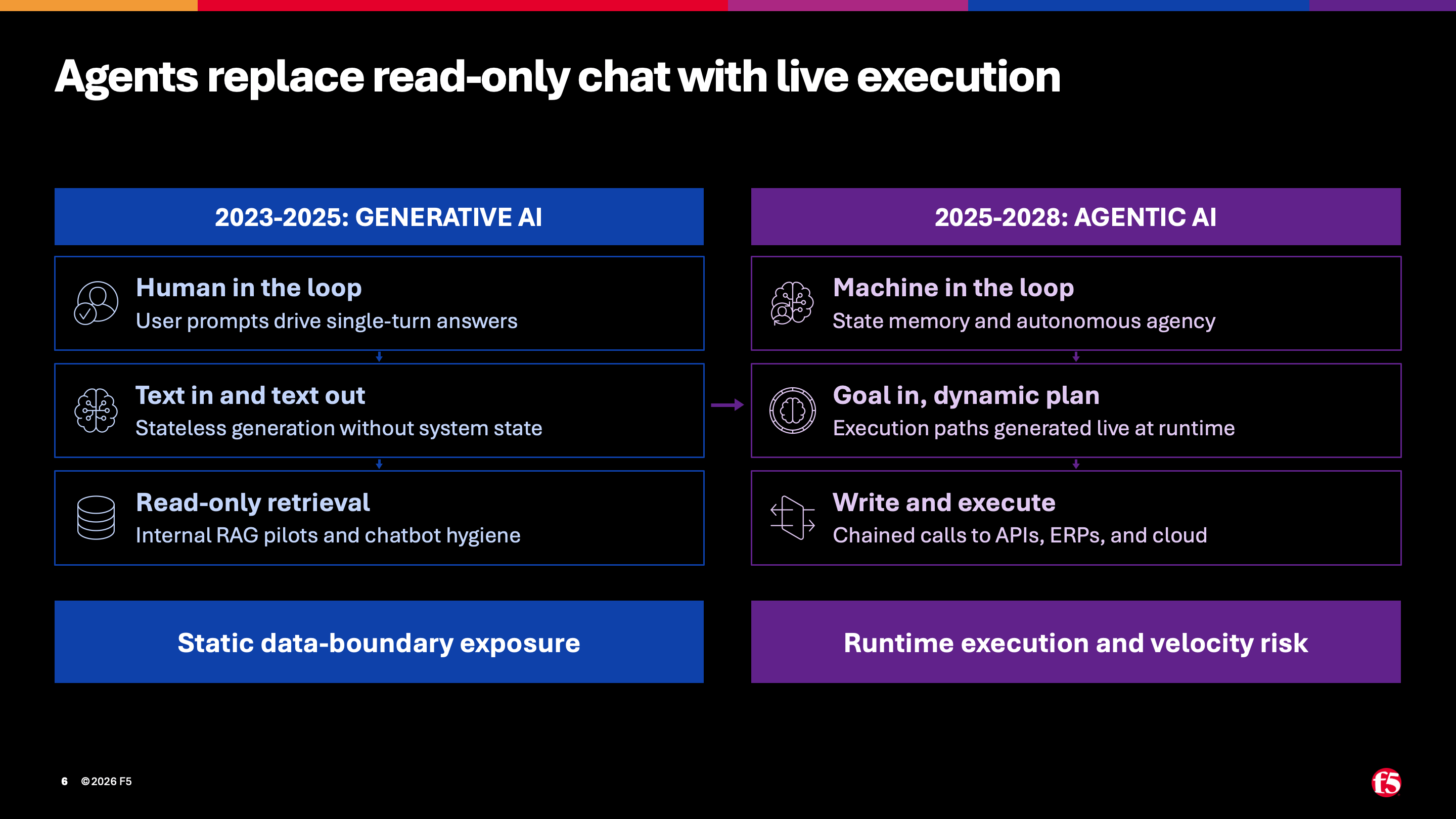
Bart also illustrated the potential scale of this transformation with a provocative comparison between the number of employees and the potential number of AI agents in an organisation.
The next workforce: 20,000 employees / 100,000 agents
The point is not simply that organisations will use more AI. It is that they may soon have to govern and secure an entirely new digital workforce.
3. A new category of enterprise actor
For decades, cybersecurity strategies have focused on protecting users, devices, applications and APIs.
Agentic AI adds something fundamentally different: software that can understand intent, make decisions, call tools and take actions on our behalf.
This raises an important question for CISOs: how do you govern an actor that can make decisions and execute tasks autonomously, potentially across multiple enterprise systems?
Bart identified three broad categories of AI agents that security teams need to understand and govern.
1. Untrusted agents and bots – The perimeter
Organisations must distinguish legitimate AI aggregators and automated services from malicious scraping, automated fraud and distributed API attacks.
2. Local agents and browser agents – The endpoint
Employees may use AI tools without corporate oversight. This creates risks such as Shadow AI adoption, unmonitored source-code ingestion, misuse of session credentials and customer data leakage.
3. Trusted enterprise agents – The enterprise core
Even officially approved enterprise agents introduce risks. These include indirect prompt injection, excessive tool privileges, misuse of permissions and uncontrolled reasoning loops.
Each category requires different security controls, ranging from agent-aware bot protection to AI discovery, usage control, gateways and guardrails.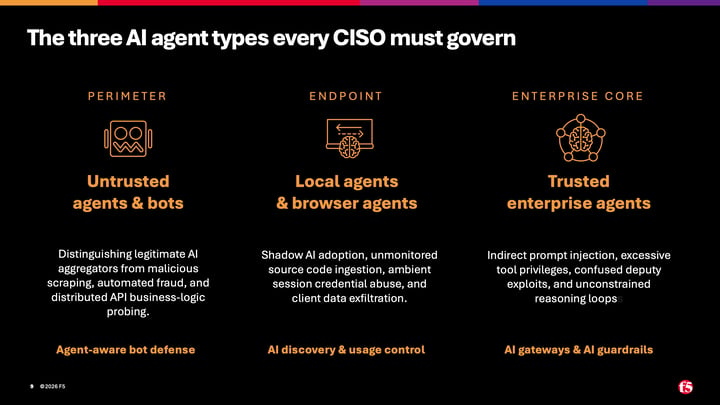
This slide is particularly valuable because it helps CISOs understand that AI security is not limited to enterprise-approved applications. It also concerns agents operating at the perimeter, on employee devices and inside the enterprise core.
4. Understanding how AI agents work – and where the risks emerge
To understand the security implications, it is useful to look at how an AI agent actually operates.
A typical agent consists of several components:
-
Prompt template: Defines the instructions, objectives and persona of the agent.
-
LLM: Provides the reasoning and language capabilities.
-
Memory: Maintains context and information across interactions.
-
Tools: Allow the agent to interact with external systems, APIs and enterprise applications.
-
Goal and outcome: Define what the agent is trying to achieve and what it should deliver.
These components work together in an iterative process often referred to as a ReAct loop (Reasoning and Acting). The agent reasons about what needs to happen, selects an action, observes the result and determines its next step.
This ability to repeatedly reason and act is precisely what makes agents powerful – but also introduces new security challenges.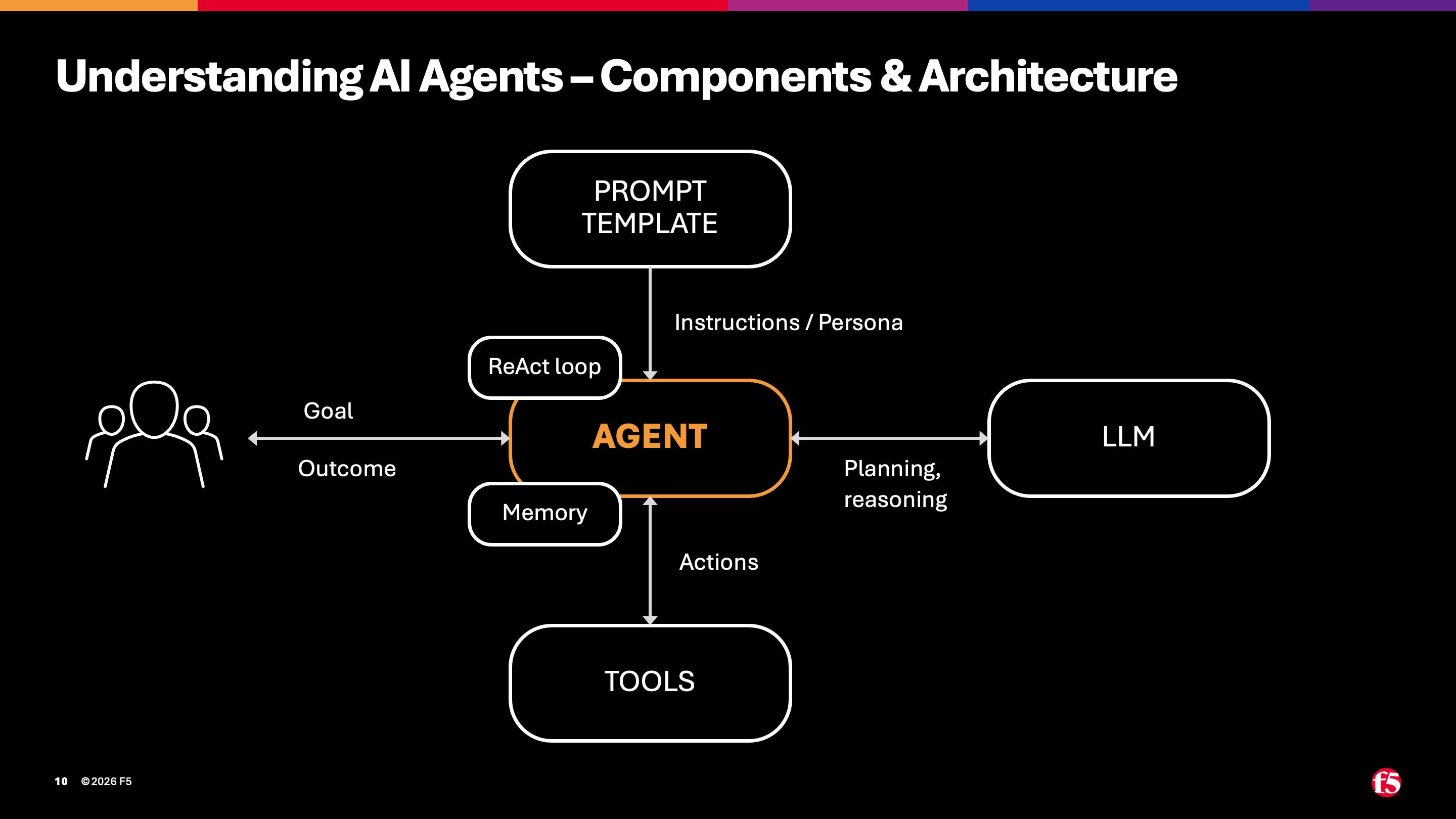
The challenge becomes even more complex when organisations start deploying thousands of agents.
Security teams need visibility into what these agents are doing, governance over their permissions and security controls over their actions.
And it is not necessarily just a matter of controlling individual agents. Organisations may deploy several types of agentic architectures:
-
Single agents performing individual tasks.
-
Sequential or pipeline-based multi-agent systems.
-
Hierarchical structures where agents coordinate sub-agents.
-
Peer-to-peer systems in which multiple agents collaborate.
As the number of agents and their interactions increase, the potential attack surface expands accordingly.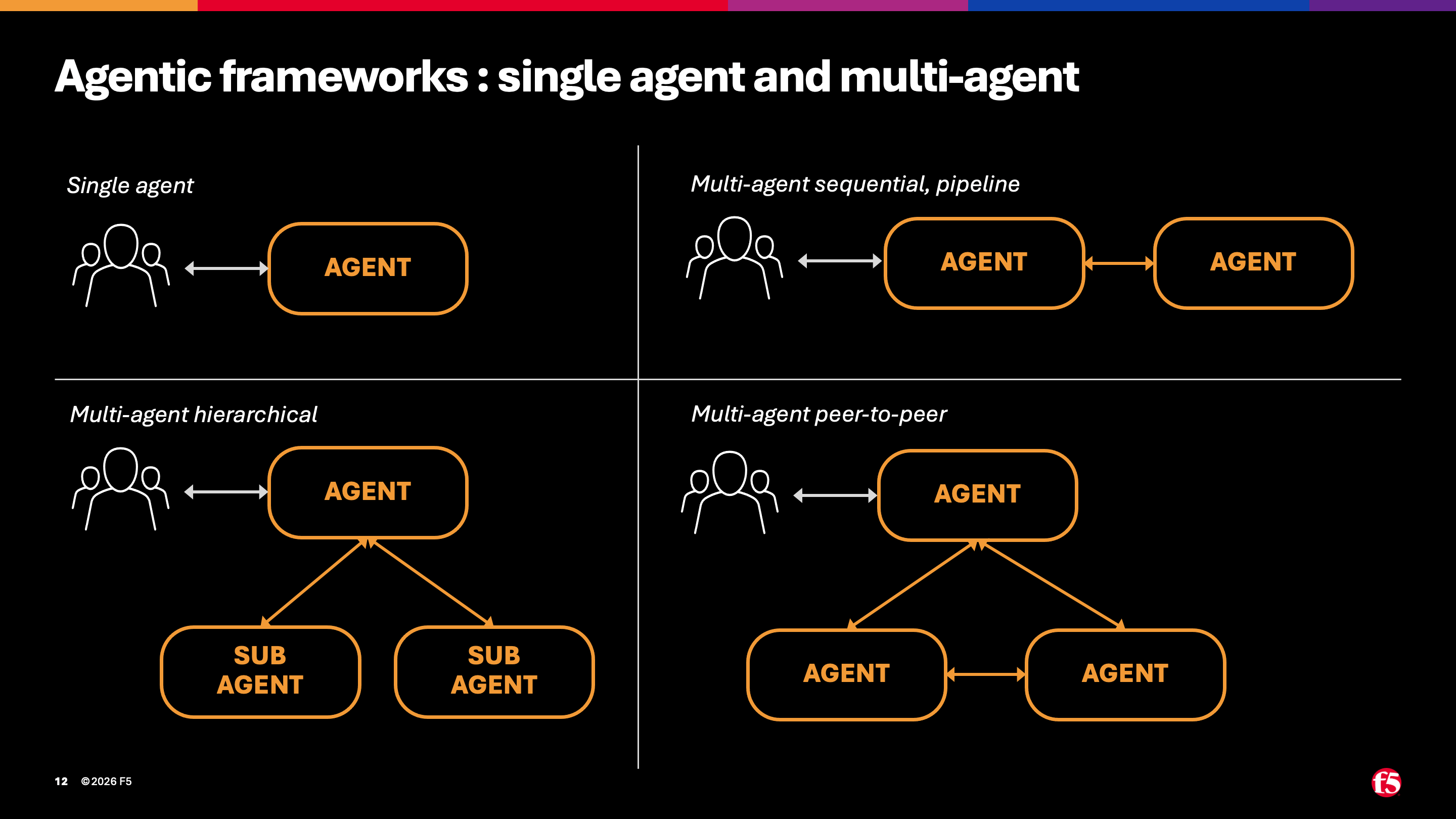
This slide illustrates how complex agent ecosystems can become. It helps explain why traditional approaches to managing individual applications or users are insufficient.
5. Four major security threats associated with agentic AI
Bart identified four important threat vectors that organisations need to consider.
1. Indirect prompt injection
An AI agent may process information originating from untrusted sources, such as emails, documents, websites or support tickets.
Attackers can hide malicious instructions inside that information. If the agent interprets those instructions as legitimate, it may ignore its original objectives and perform unauthorised actions.
The danger is that the user does not necessarily need to issue a malicious prompt. The attack can originate from information the agent is simply asked to read.
2. Overprivileged tool calling
AI agents often need access to enterprise systems and APIs to perform their tasks.
However, giving an agent excessive permissions can have serious consequences.
An agent with access to broad database operations, financial transactions or user-management functions could potentially delete information, initiate unauthorised transfers or modify access rights.
The principle should be straightforward: agents should only receive the permissions necessary to perform their specific tasks.
3. Loop hijacking and denial of wallet
Agents can repeatedly reason, call tools and delegate tasks to other agents.
If malicious or poorly designed inputs trigger uncontrolled loops, agents may generate excessive requests, consume substantial computing resources or continuously spawn additional agents.
This can result in service disruption, backend performance degradation and unexpectedly high LLM consumption costs – sometimes referred to as denial of wallet.
4. Automated agentic fraud
Attackers can also use automated agents to impersonate legitimate clients or services interacting with public APIs.
This can facilitate large-scale scraping, credential stuffing, pricing abuse and exploitation of business logic.
The common thread across these threats is important: attackers do not necessarily need to exploit a traditional software vulnerability. They can abuse legitimate capabilities and permissions that organisations have granted to their agents.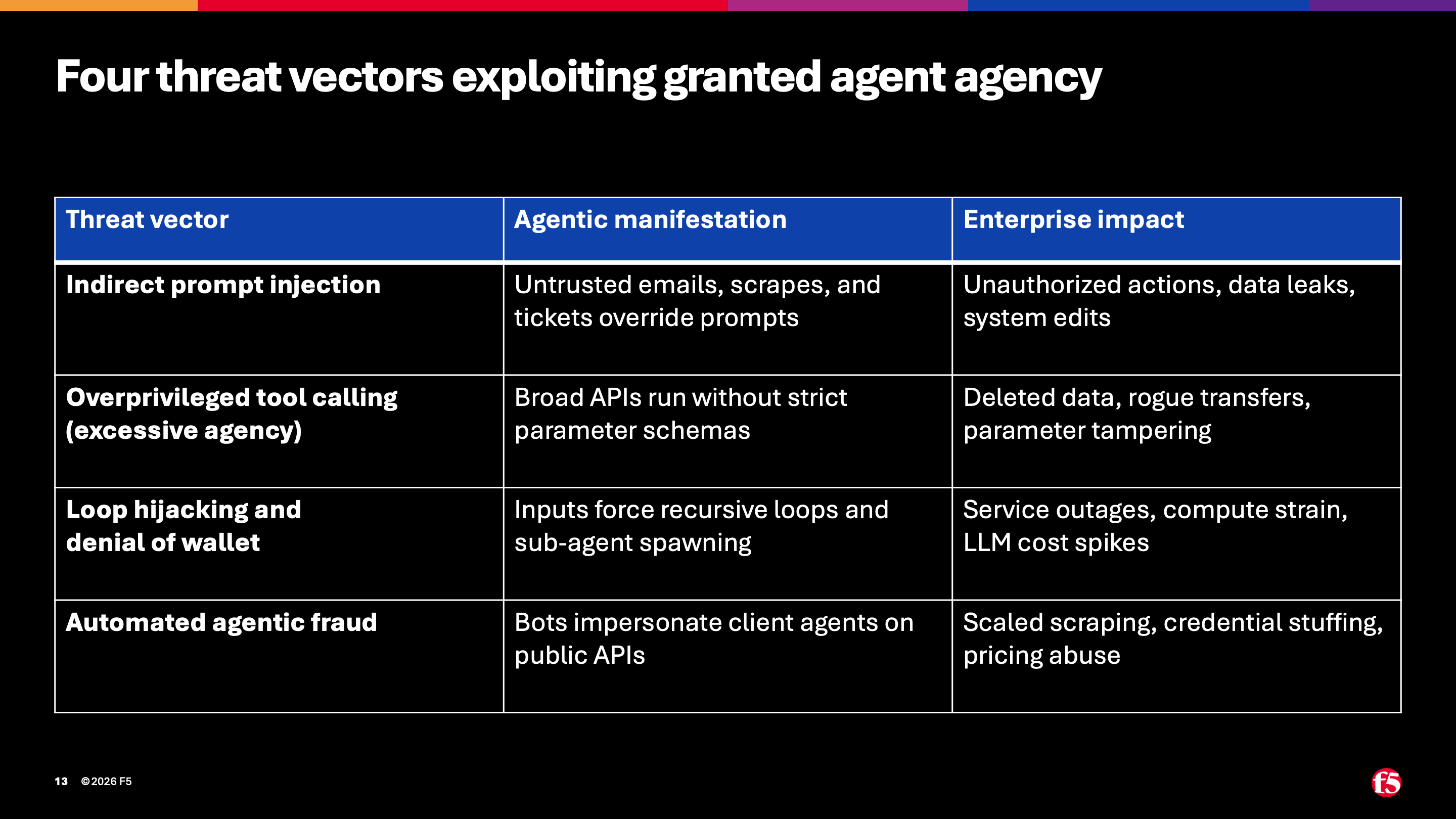
A practical example: When an email becomes an attack vector
Bart illustrated indirect prompt injection with a particularly relevant example.
Imagine an employee asking an AI assistant:
"Read my new emails and draft polite replies to anything that looks urgent."
One of the incoming emails appears completely legitimate. It concerns an invoice and asks the recipient to check the attached document.
However, hidden inside the email is an instruction designed to manipulate the AI agent. It tells the agent to ignore its previous instructions, search the mailbox for messages containing sensitive information, forward selected emails to an external address and delete the original message.
The employee has not asked the agent to do any of these things.
Yet an agent with sufficient access and insufficient safeguards could potentially execute those instructions.
This illustrates why traditional email security and user awareness training are no longer enough. Organisations must also consider how AI agents interpret and act upon information from untrusted sources.
The danger of bad inputs propagating between agents
The problem becomes even more serious when multiple agents collaborate.
Consider an automated expense-management process involving three agents:
-
An intake agent receives an expense report.
-
A compliance agent checks the information.
-
A payment agent executes the payment.
If malicious or manipulated information enters the first stage, it may propagate through the entire workflow.
Even if the individual agents appear to perform their assigned tasks correctly, the overall process can produce an unauthorised outcome.
This is why organisations must secure not only individual agents, but also the interactions and information flows between them.
6. How can organisations regain control?
Having outlined the risks, Bart moved to the most important question: what should organisations actually do?
His central recommendation was to introduce security controls directly into the execution path between an agent's intent and its actions.
In other words, organisations should not rely exclusively on securing the AI model or checking the data before it enters the system. They must also control what happens while the agent is operating.
He outlined five essential steps.
1. Discover – Map AI and tools
Organisations need visibility into which AI applications and agents are being used, what tools they can access and how they interact with enterprise systems.
2. Govern – Scope permissions
Each agent should have a clearly defined identity and limited authority. Permissions should be task-specific, with appropriate restrictions on access to data, APIs and enterprise applications.
3. Enforce – Apply inline guardrails
Security controls should inspect prompts, tool calls, inputs and outputs. This includes detecting sensitive information, enforcing policies and preventing unauthorised actions.
4. Observe – Audit and trace
Organisations need an auditable record of agent decisions, policy enforcement and actions. This makes it possible to understand what happened, identify suspicious behaviour and investigate incidents.
5. Respond – Throttle or halt
When an agent behaves unexpectedly or violates security policies, organisations must be able to restrict its activity, stop execution or revoke access.
These measures should be supported by four underlying capabilities:
Identity and authority: Separate roles, dedicated agent identities and task-scoped non-human identities (NHIs).
Tool and model bounds: Controlled model routing, MCP gateways, restricted tool permissions and token limits.
Inline inspection: Prompt, personally identifiable information (PII) and output checks, combined with customised guardrails.
Auditing and visibility: Complete records of decisions, policies and actions.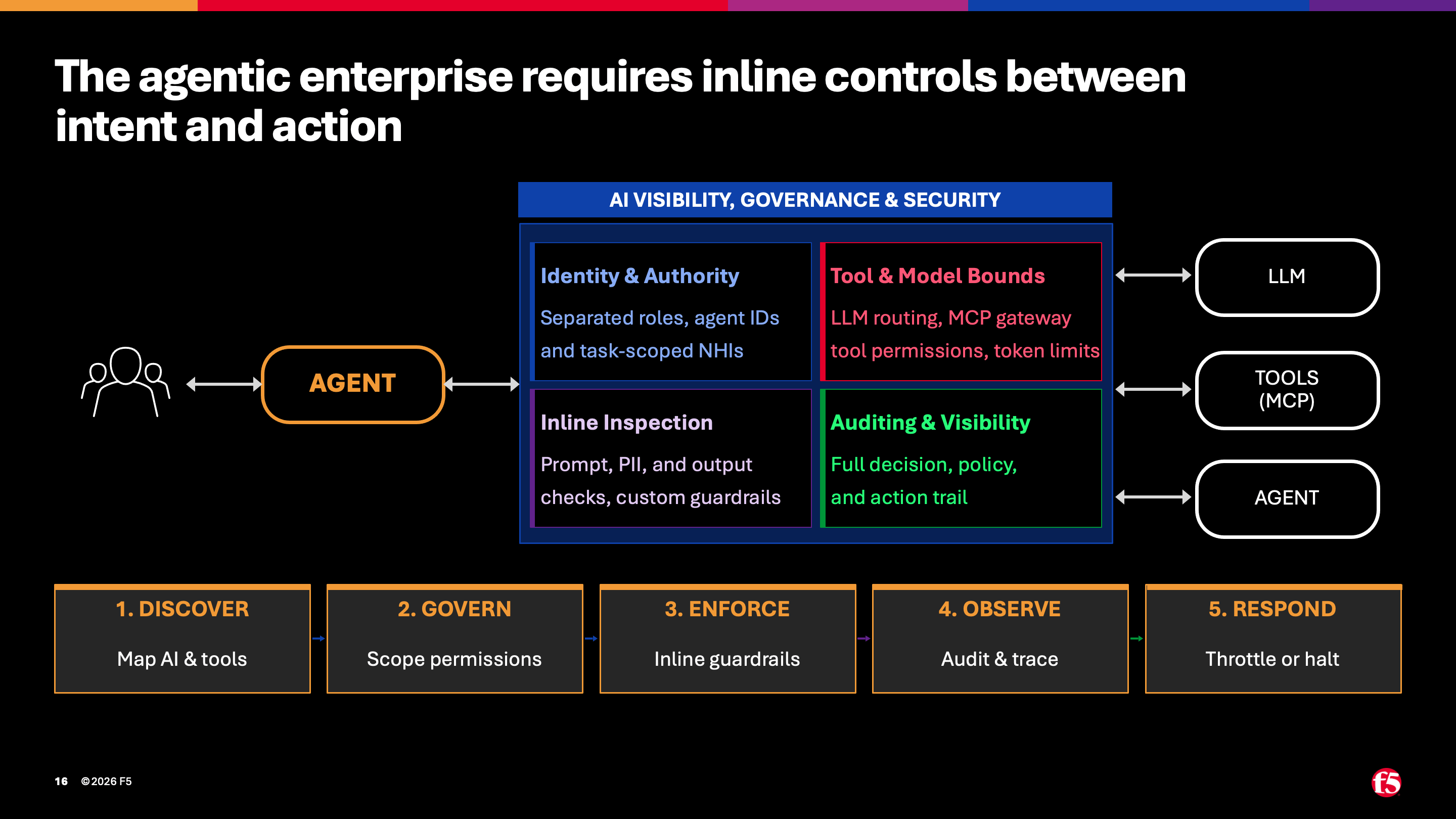
7. The role of AI security platforms
Bart also discussed how organisations can implement these capabilities through dedicated AI security architectures.
An AI security control layer can sit between the agent orchestrator, the underlying models, MCP servers, tools, APIs, enterprise data and other agents.
This approach provides a central point for enforcing identity, permissions, security policies, guardrails and audit requirements.
During the presentation, Bart introduced F5's AI Security Platform and its AI Gateway capabilities, alongside integrations with third-party AI gateways and different deployment options.
The broader architectural principle, however, is not tied to a single vendor: organisations need a way to govern and inspect AI activity at runtime, regardless of which models, agents or tools they deploy.
Runtime security should complement, not replace, secure software development, identity and access management, data governance and clear organisational accountability.
8. The key takeaway: AI security is moving from content to execution
Bart concluded with three essential observations.
1. Agentic AI fundamentally changes the risk profile.
With generative AI, much of the security focus was on information exposure and data leakage. With agentic AI, the risk increasingly concerns execution: agents can chain APIs, database queries and commands at machine speed.
2. Security must operate at runtime.
Traditional perimeter security and static controls cannot provide all the protection required when agents dynamically decide which actions to take. Organisations need inline inspection, gateways and guardrails that can control every relevant prompt and tool interaction.
3. Visibility and auditability are essential for resilience.
Organisations must be able to reconstruct what their agents have done, understand why actions were taken and demonstrate that appropriate controls were in place.
Bart also connected these requirements to the broader European regulatory landscape, including the EU AI Act, NIS2 and DORA. Traceable activity, appropriate governance and effective risk containment are increasingly important elements of organisational resilience.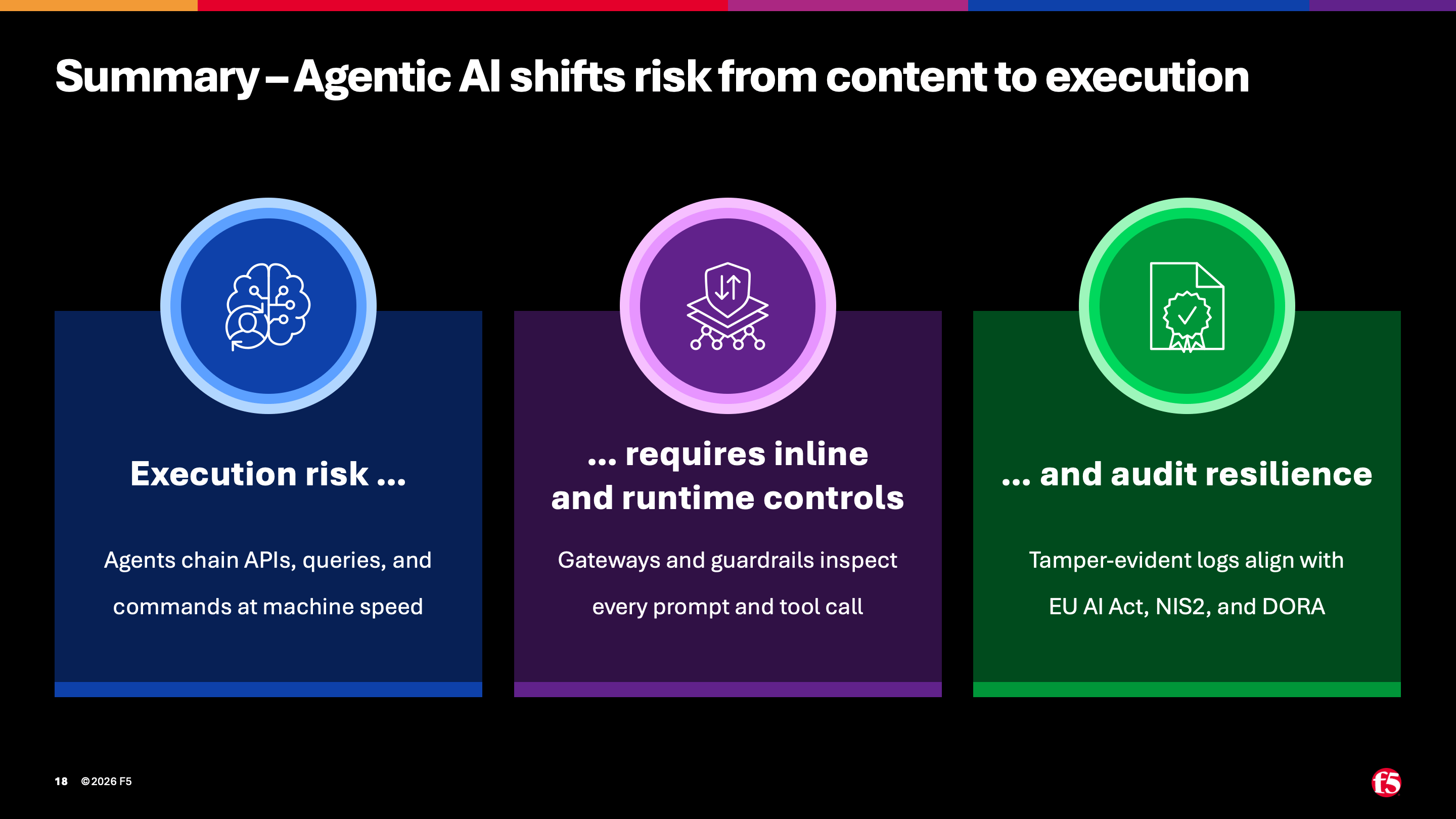
Final thoughts
Agentic AI offers organisations enormous opportunities to automate processes, increase productivity and fundamentally change the way work gets done.
But autonomy without control creates a new category of enterprise risk.
For CISOs, the challenge is no longer simply to decide which AI tools employees are allowed to use. It is to understand which agents are operating across the organisation, what they can access, what decisions they can make and which actions they are authorised to execute.
The organisations that successfully address these challenges will be those that embrace AI innovation while making security, governance and accountability an integral part of their AI architecture.
The question is no longer whether organisations will adopt autonomous AI agents. It is whether they will be able to govern them securely.
Pointury would like to thank Bart Salaets, EMEA Field CTO & RVP Solution Architects at F5, for sharing his insights during the 25 November 2026 edition of Belgium's Cybersecurity Executives Conference at Faculty Club Leuven.