
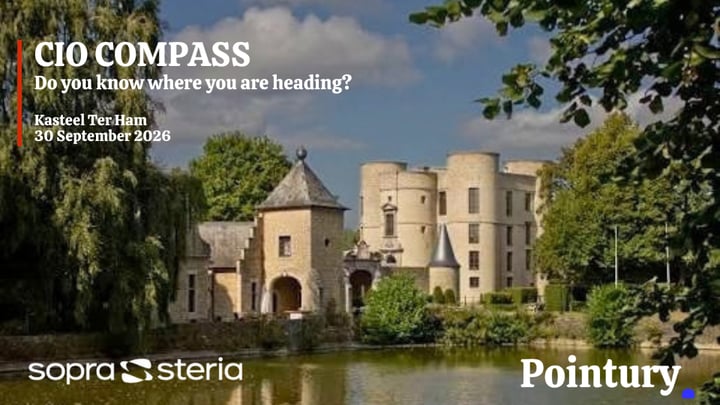
CIO COMPASS: A CLEARER VIEW OF WHERE TECHNOLOGY LEADERS ARE HEADING
Presented by Simon Kaye, Consulting Director, Tech Advisory and Wouter Buckinx, Director Data and AI at Sopra Steria on September 30, 2026 at Kasteel ter Ham, Sreenokkerzeel
Where are we heading?
That was the central question behind the CIO Compass round table at Kasteel Ter Ham on September 30, where technology leaders came together over dinner to discuss the priorities, opportunities and tensions shaping the next 12 to 18 months.
The evening, hosted together with Sopra Steria, was deliberately designed around discussion rather than presentations. The objective was not to provide another technology roadmap, but to create the opportunity for CIOs and other digital leaders to compare experiences, challenge assumptions and reflect on the choices they are making in their own organisations.
And there is certainly no shortage of choices.
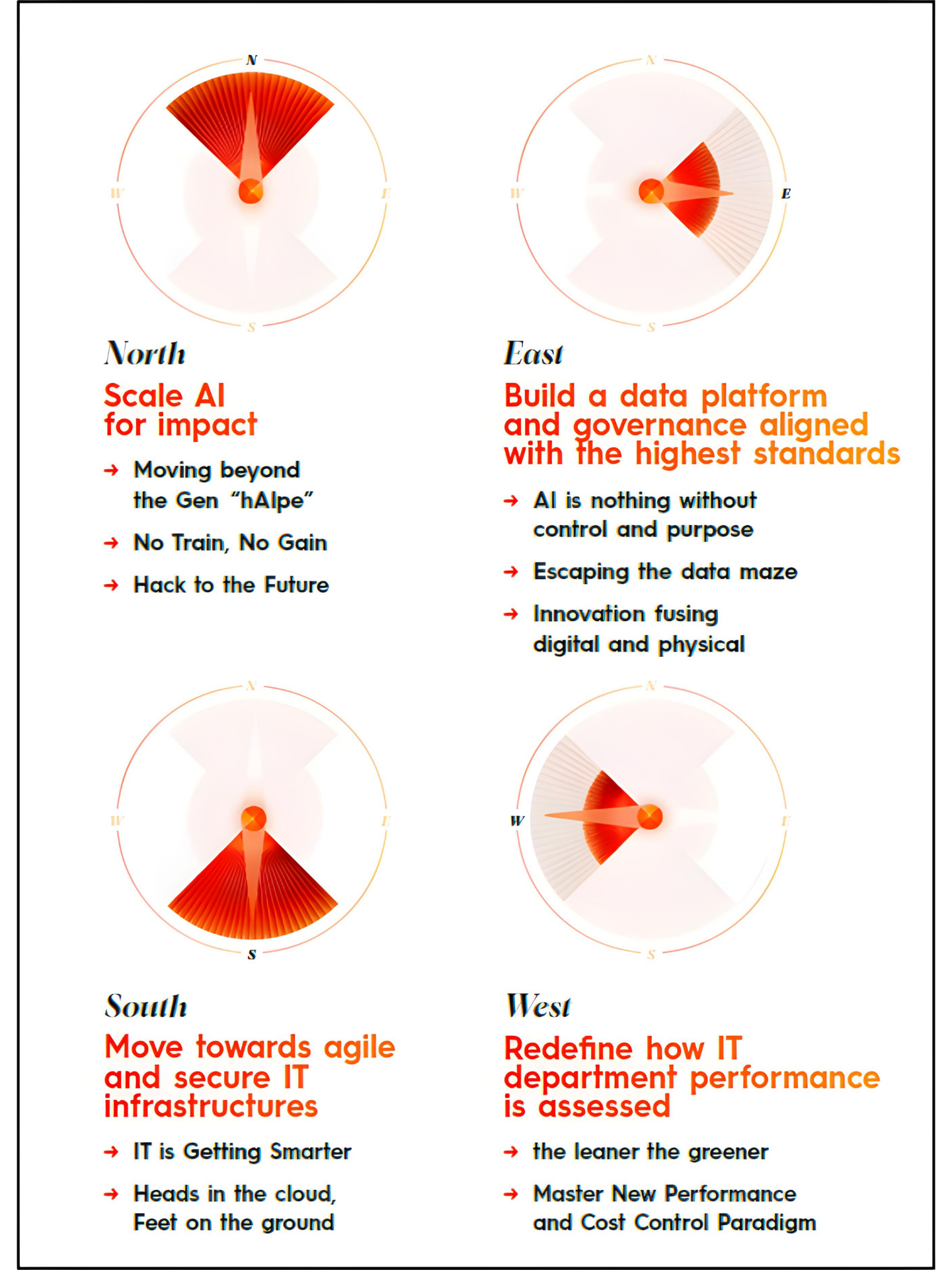
The compass provides four directions — North, East, South and West — and a framework for asking the right questions about the journey ahead.
NORTH : AI
The AI paradox: massive investment, limited business impact
AI was inevitably at the centre of the conversation.
While we all use AI for personal efficiency, using it for bringing business value is still limited.
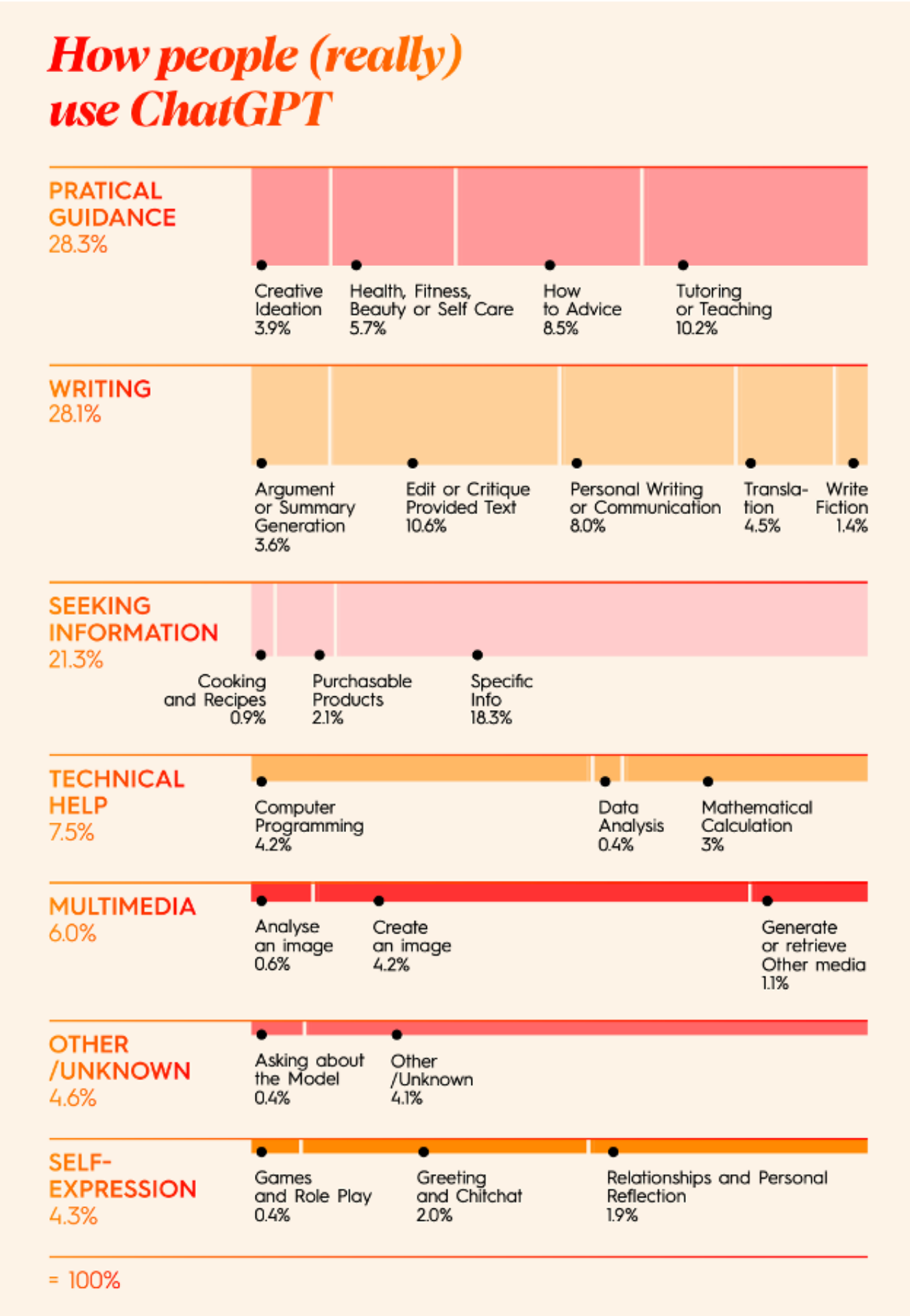
The scale of investment is extraordinary. The CIO Compass presentation highlighted forecasts of $2.8 trillion in AI capital expenditure by 2029, including more than $500 billion in 2026 alone. At the same time, the presentation pointed to the difficulty organisations are experiencing in turning that investment into sustainable business impact: many AI initiatives remain stuck in pilot phases, while only a minority reach stable production.
This creates a fundamental dilemma for technology leaders.
The question is no longer simply how much should we invest in AI? It is increasingly:
Which AI investments will actually survive the hype?
The discussion moved beyond generative AI itself towards the broader opportunities for AI-enabled organisations: augmenting human work, accelerating software engineering, automating processes through agentic workflows and eventually supporting intelligent physical operations.
But opportunity comes with new responsibilities.
AI cannot be separated from questions of data, governance, security, accountability and sovereignty. As the presentation put it, AI is nothing without purpose and control. Responsibility needs to be clear not only for the models, but also for the data, platforms, APIs and ultimately the decisions influenced or made by AI.
EAST : DATA
A trusted data foundation remains essential
The second direction of the CIO Compass was data.
AI may be attracting most of the attention, but its effectiveness depends heavily on the quality, accessibility and governance of the data underneath it.
For technology leaders, this means that the AI agenda cannot simply sit alongside the data strategy. The two are increasingly inseparable.
The conversation therefore also touched on an important question: can we trust the data on which increasingly important business and technology decisions are based?
That question becomes even more important as organisations move from experimentation towards AI embedded in operational processes.
What CIOs must explicitly refuse:
-
AI models trained on noncertified data
-
AI POCs running outside governance frameworks
-
Purely declarative governance (documentation without executable controls)
-
AI tools disconnected from the data catalog and metadata ecosystem
SOUTH : AGILE AND SECURE INFRASTRUCTURE
From IT operations to intelligent operations
Another theme was the increasing complexity of the technology environment.
Cloud platforms, distributed architectures, AI services and growing numbers of applications and APIs create an environment in which simply collecting more monitoring data is not enough.
The CIO Compass presentation positioned observability and AIOps as ways of turning scattered technical signals into usable evidence.
Different forms of AI can contribute at different levels: pattern recognition can reduce alert noise; causal analysis can help identify likely causes and impact; predictive AI can anticipate risks; generative AI can help teams understand incidents; and agentic AI can potentially execute approved remediation workflows.
But technology alone does not create autonomous operations.
As discussed during the session, organisations need to align their operating model, telemetry strategy and automation around a limited number of high-impact operational loops.
That is a very different proposition from simply buying another monitoring or automation tool.
Your challenge: "Deliver IT that is faster, cheaper, safer, greener, and smarter"
WEST : IT PERFORMANCE ASSESMENT
IT needs to demonstrate measurable value
The final direction was perhaps the most fundamental one: how do we measure whether IT is actually delivering value?
The presentation highlighted the growing importance of FinOps-driven automation, with examples of cloud-cost reductions achieved through rightsizing, commitment management, automated identification of unused resources and improved cost allocation.
But the discussion went beyond reducing the cloud bill.
The role of the CIO is changing. Technology leaders increasingly need to understand cost, investment, sustainability, business value and organisational impact at the same time.
The presentation described the emerging post-CAPEX CIO as not only a technology leader, but also a cost architect, investment strategist and sustainability guardian.
That requires new disciplines, including:
- FinOps mastery – understanding and controlling technology consumption and cost
- GreenOps discipline – connecting technology costs with environmental impact
- Dynamic allocation – continuously directing funding towards value
- Sovereignty by design – reducing unwanted dependencies and increasing resilience
- Operating models for value – moving beyond projects towards products and continuous value delivery
Eight tensions every CIO needs to navigate
Perhaps the most useful way to summarise the evening is not as a list of technologies, but as a series of tensions.
Technology leaders are being asked to reconcile:
-
Speed and safety.
- Local freedom and central control.
-
Cost cutting and future innovation.
-
Human accountability and machine autonomy.
-
Sovereignty and innovation.
-
AI efficiency and energy consumption.
-
Visibility and information overload.
-
Simplicity for users and increasingly complex skills requirements
These tensions cannot simply be eliminated. They are part of the job of the modern technology leader.
So, do we know where we are heading?
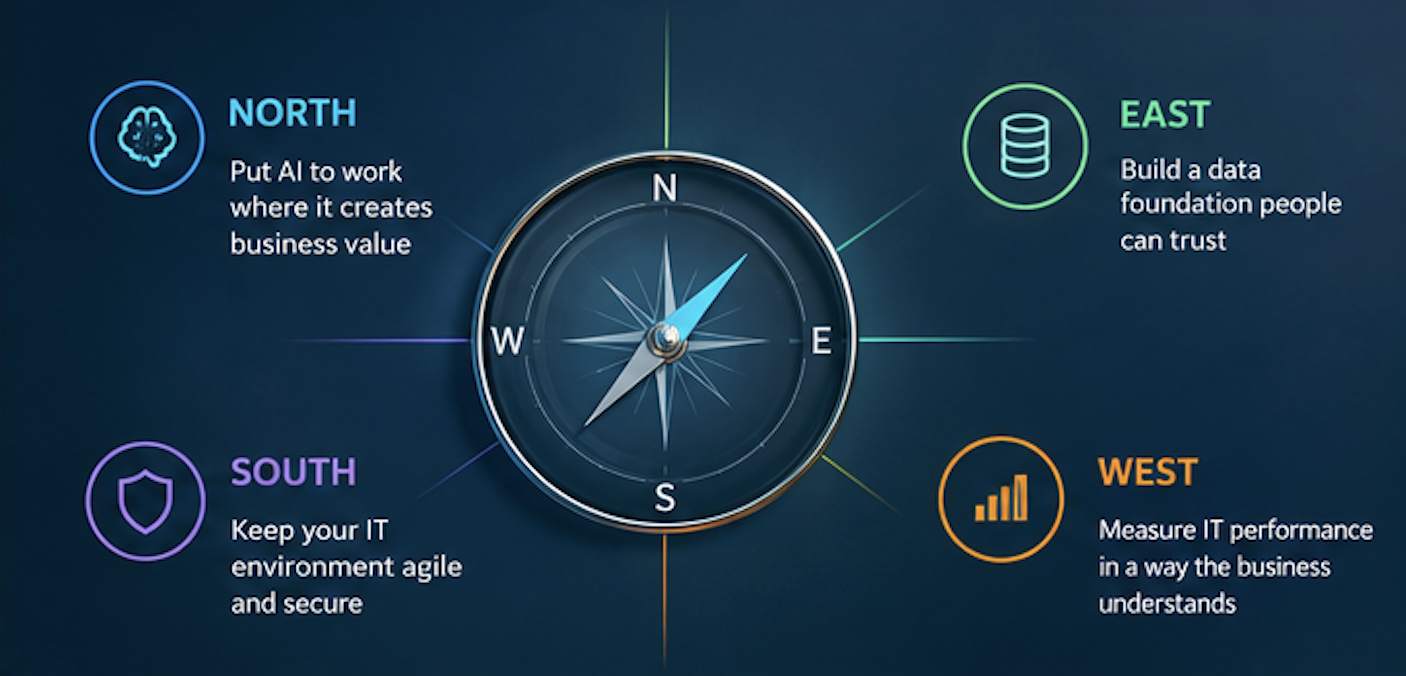
Perhaps the most important conclusion from the CIO Compass evening is that the answer is not a single technology roadmap.
The next phase of digital leadership is about making better choices: deciding where AI genuinely creates value, building a data foundation that can be trusted, operating increasingly complex environments with greater visibility and automation, and demonstrating the value of technology in terms the business understands.
And, as the evening demonstrated, sometimes the most valuable part of the journey is simply sitting around the table with peers and comparing notes.
Thank you to everyone who joined the CIO Compass round table at Kasteel Ter Ham, and to the Sopra Steria team for sharing their perspectives and creating the basis for an open discussion.

Sopra Steria is one of Europe’s leading technology and consulting companies, helping organisations drive digital transformation and create sustainable business value. Combining expertise in consulting, digital services, software development and emerging technologies such as AI and data, the company supports businesses and public organisations in navigating complex challenges and accelerating innovation. With more than 50,000 employees across nearly 30 countries, Sopra Steria works with a strong belief that technology should create meaningful impact for people, organisations and society.